Rust 04. Ownership, Borrowing, and Lifetimes
When learning Rust, the terms you hear over and over are ownership, borrowing, and lifetime. These ideas are the core reason Rust can provide memory safety without relying on a garbage collector. They may feel unusual at first, but the overall flow becomes much easier once you understand move, references, and scope.
This post explains how ownership moves, why borrowing is needed, and when lifetime annotations appear, all centered around small String examples you can run right away.
Create a Practice Project
Create a new Cargo project like this and run each example in src/main.rs.
cargo new rust-ownership-basics
cd rust-ownership-basics
code .
After pasting in an example, run it with:
cargo run
Why Ownership Matters
Rust does not allow values to be copied and freed casually from anywhere in the program. Instead, it checks at compile time who is responsible for each value. That idea is ownership.
The three core ownership rules are:
- Each value has one owner.
- Only one owner exists at a time.
- When the owner goes out of scope, the value is dropped.
Because of these rules, Rust can prevent problems such as double free, use-after-free, and data races before the program even runs.
Scope and Drop
The first thing to understand is what happens when a value leaves its scope.
fn main() {
    {
        let message = String::from("hello");
        println!("{}", message);
    }

    // message is no longer valid here.
}
message is valid only inside the block. Once the block ends, the owner disappears, and Rust cleans up the memory that the String was using. If you come from C++, this can feel similar to RAII, but Rust enforces the rules much more explicitly through ownership and the borrow checker.
Move: Ownership Transfer
With a type such as String, assignment is treated as a move rather than a simple copy.
fn main() {
    let s1 = String::from("hello");
    let s2 = s1;

    println!("{}", s2);
}
In this code, ownership of s1 moves to s2. That means s2 is valid, but s1 is no longer usable.
If you try to use s1 again, you get a compile error.
fn main() {
    let s1 = String::from("hello");
    let s2 = s1;

    println!("{}", s1);
    println!("{}", s2);
}
The compiler output looks like this.
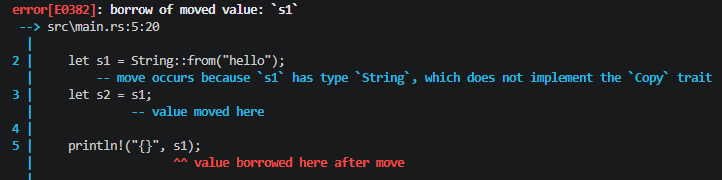
Why does Rust do this? A String stores its character data on the heap. If Rust allowed both s1 and s2 to behave like owners of the same heap allocation, both of them could try to free the same memory when leaving scope. Rust prevents that by invalidating the old binding at the point of the move.
Clone vs Copy
If you really want a separate copy of the data, use clone().
fn main() {
    let s1 = String::from("hello");
    let s2 = s1.clone();

    println!("s1 = {}", s1);
    println!("s2 = {}", s2);
}
The output looks like this.

In this case, s1 and s2 each own their own heap data.
By contrast, Copy does not simply mean “small and on the stack.” In Rust, a type can implement Copy when all of its components are Copy and it does not require cleanup through Drop. For such types, assignment duplicates the value instead of moving ownership.
fn main() {
    let x = 10;
    let y = x;

    println!("x = {}", x);
    println!("y = {}", y);
}
The output looks like this.

Types such as i32, bool, char, some fixed-size tuples, and shared references like &T copy naturally. Types that own resources or require cleanup, such as String and Vec<T>, are not Copy by default.
Borrowing: Using a Value Without Taking Ownership
If every function call moved ownership, Rust would become awkward very quickly. To avoid that, Rust lets you borrow a value through a reference.
fn print_length(text: &str) {
    println!("length = {}", text.len());
}

fn main() {
    let message = String::from("hello rust");
    print_length(&message);

    println!("message = {}", message);
}
The output looks like this.
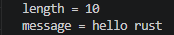
Here, print_length receives a &str reference. Ownership of message stays in main, and the function only borrows it briefly to read the length. That is why message is still available after the function call.
Early on, &String and &str can feel confusing. In practice, when a function only needs read-only string data, &str is usually the more flexible choice.
Immutable Borrow and Mutable Borrow
References are mainly divided into immutable borrow and mutable borrow.
You can have multiple immutable borrows at the same time.
fn main() {
    let message = String::from("rust");

    let r1 = &message;
    let r2 = &message;

    println!("{}, {}", r1, r2);
}
The output looks like this.

That is safe because both references only read the same value.
If you want to modify the value, you need a mutable borrow.
fn add_suffix(text: &mut String) {
    text.push_str(" ownership");
}

fn main() {
    let mut message = String::from("rust");
    add_suffix(&mut message);

    println!("{}", message);
}
The output looks like this.

The key rule is that only one mutable borrow is allowed at a time. Also, you cannot create a mutable borrow while immutable borrows are still alive.
The following code produces an error.
fn main() {
    let mut text = String::from("hello");

    let r1 = &text;
    let r2 = &mut text;

    println!("{}, {}", r1, r2);
}
The compiler error looks like this.
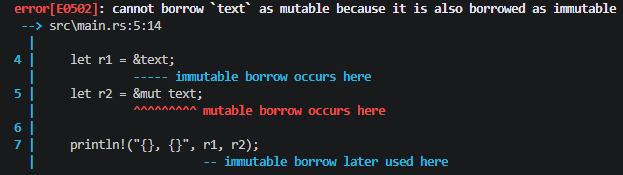
Rust rejects this because one reference wants to read while the other wants to modify the same value at the same time.
If needed, you can separate the usage periods of the references.
fn main() {
    let mut text = String::from("hello");

    {
        let r1 = &text;
        println!("{}", r1);
    }

    let r2 = &mut text;
    r2.push_str(" rust");

    println!("{}", r2);
}
The output looks like this.

Once the immutable borrow is finished, creating the mutable borrow becomes fine.
Dangling References and Why Lifetimes Matter
Borrowing rules also prevent dangling references. A dangling reference is a reference that points to data that has already been dropped.
The following code is not allowed.
fn dangle() -> &String {
    let text = String::from("hello");
    &text
}
text is dropped when the function ends, so returning a reference to it would create a reference to invalid memory. Rust blocks that at compile time.
In this case, the fix is to return ownership instead of a reference.
fn no_dangle() -> String {
    let text = String::from("hello");
    text
}
A Classic Lifetime Annotation Example
For many references, the compiler can infer lifetimes automatically. But when a function accepts multiple references and returns one of them, you sometimes need to describe the relationship explicitly with a lifetime annotation.
The classic example is longest.
fn longest<'a>(x: &'a str, y: &'a str) -> &'a str {
    if x.len() >= y.len() {
        x
    } else {
        y
    }
}
Here, 'a is not a real runtime value. It is a way to connect the valid ranges of the references. This function does not mean the returned reference always lives as long as whichever input lasts longer. It means the returned reference is valid only within the range that both input references share. In practice, it is safest to think of the result as being limited by the shorter of the two input lifetimes.
Here is a valid usage example.
fn longest<'a>(x: &'a str, y: &'a str) -> &'a str {
    if x.len() >= y.len() {
        x
    } else {
        y
    }
}

fn main() {
    let first = String::from("rust");
    let second = String::from("ownership");

    let result = longest(first.as_str(), second.as_str());
    println!("longer = {}", result);
}
The output looks like this.

This is safe because both first and second live long enough inside main.
Lifetimes in Structs That Store References
If a struct stores a reference in one of its fields, it also needs a lifetime parameter.
struct Highlight<'a> {
    part: &'a str,
}

fn main() {
    let article = String::from("Rust ownership makes memory safety practical.");
    let first_word = article.split_whitespace().next().unwrap();

    let highlight = Highlight { part: first_word };
    println!("{}", highlight.part);
}
The output looks like this.

Highlight<'a> means the part reference inside the struct must remain valid for at least 'a. In other words, the struct is not allowed to outlive the original string it refers to.
Combined Example
Here is a single example that combines the key ideas from this post.
fn print_length(text: &str) {
    println!("length = {}", text.len());
}

fn add_suffix(text: &mut String) {
    text.push_str(" ownership");
}

fn longest<'a>(x: &'a str, y: &'a str) -> &'a str {
    if x.len() >= y.len() {
        x
    } else {
        y
    }
}

struct Highlight<'a> {
    part: &'a str,
}

fn main() {
    let mut title = String::from("Rust");
    print_length(&title);

    add_suffix(&mut title);
    println!("title = {}", title);

    let first = String::from("Ownership");
    let second = String::from("Borrowing");
    let longer = longest(first.as_str(), second.as_str());

    println!("longer = {}", longer);

    let article = String::from("Rust ownership makes memory safety practical.");
    let first_word = article.split_whitespace().next().unwrap();
    let highlight = Highlight { part: first_word };

    println!("highlight = {}", highlight.part);
}
This example includes immutable borrowing, mutable borrowing, lifetime annotations, and a struct that stores a reference. It is often easiest to run each small example first and then come back to this combined version at the end.
Summary
This post covered ownership, borrowing, and lifetimes as one connected flow. The key idea is that values such as String move by default, references let you use a value without taking ownership, and lifetime annotations describe how borrowed references are related when the compiler needs help.
The borrow checker can feel strict at first, but once you get used to it, you start seeing the benefit of catching memory safety problems during compilation rather than at runtime. A practical next step is to continue with struct, enum, Result, and Option, where these ownership rules become even more meaningful in real Rust code.
댓글남기기