Rust 06. Generics, Error Handling, Closures, and Iterators
Once you get more comfortable with Rust, four topics start appearing everywhere: how to reuse the same logic across different types, how to handle failure safely, how to treat small pieces of logic like values, and how to process collections cleanly. Those ideas are covered by generics, error handling, closures, and iterators.
This post explains those four topics at a beginner-friendly level. Each one may look like separate syntax at first, but in real Rust code they very often work together.
Create a Practice Project
Create a new Cargo project like this and run the examples in src/main.rs.
cargo new rust-generics-errors-closures
cd rust-generics-errors-closures
code .
After pasting an example into src/main.rs, run it with:
cargo run
Generics: Generalizing Over Types
Generics let you reuse the same logic across multiple types. For example, a function that finds the largest value can work for an array of i32 values and also for an array of char values.
fn largest<T: PartialOrd + Copy>(list: &[T]) -> T {
    let mut largest = list[0];

    for &item in list {
        if item > largest {
            largest = item;
        }
    }

    largest
}

fn main() {
    let numbers = [10, 40, 20, 30];
    let chars = ['a', 'z', 'm'];

    println!("largest number = {}", largest(&numbers));
    println!("largest char = {}", largest(&chars));
}
The output looks like this.
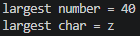
Here, T is a placeholder for a type that will be decided later. Rust still does not accept just any type here. The function requires PartialOrd so values can be compared with >, and Copy so the chosen value can be returned by value.
Generics are also common in structs.
struct Point<T> {
    x: T,
    y: T,
}

fn main() {
    let int_point = Point { x: 10, y: 20 };
    let float_point = Point { x: 1.5, y: 2.5 };

    println!("int_point = ({}, {})", int_point.x, int_point.y);
    println!("float_point = ({}, {})", float_point.x, float_point.y);
}
The output looks like this.

Point<T> represents a coordinate whose x and y share the same type T. This is a typical way to reduce duplication while keeping strong type safety.
Error Handling: Result and the ? Operator
Rust does not hide the possibility of failure. Recoverable errors are usually represented with Result<T, E>, where success is Ok and failure is Err.
fn safe_divide(a: f64, b: f64) -> Result<f64, String> {
    if b == 0.0 {
        Err(String::from("Cannot divide by zero."))
    } else {
        Ok(a / b)
    }
}

fn main() {
    match safe_divide(10.0, 2.0) {
        Ok(value) => println!("result = {}", value),
        Err(message) => println!("error = {}", message),
    }

    match safe_divide(10.0, 0.0) {
        Ok(value) => println!("result = {}", value),
        Err(message) => println!("error = {}", message),
    }
}
The output looks like this.

With match, you handle both Ok and Err explicitly, which makes failure cases much harder to ignore by accident.
Rust also provides the ? operator to make error propagation shorter and clearer.
fn add_parsed(a: &str, b: &str) -> Result<i32, std::num::ParseIntError> {
    let first = a.parse::<i32>()?;
    let second = b.parse::<i32>()?;

    Ok(first + second)
}

fn main() {
    match add_parsed("10", "20") {
        Ok(value) => println!("sum = {}", value),
        Err(error) => println!("error = {}", error),
    }
}
The output looks like this.

If ? sees an Err, it returns that error immediately to the outer function. If it sees an Ok, it unwraps the inner value. However, this only works when the outer function returns a compatible type such as Result. That makes multi-step fallible code much easier to read.
Closures: Anonymous Functions
A closure is a function without a name that you can define inline and store in a variable. It is commonly used for short logic or when you want to capture values from the surrounding environment.
fn main() {
    let bonus = 5;
    let add_bonus = |score: i32| score + bonus;

    println!("result = {}", add_bonus(10));
}
The output looks like this.

In this example, the closure uses the outer variable bonus directly. Capturing surrounding values like this is one of the main differences between closures and ordinary functions.
Rust can also infer closure types quite well, so you often see shorter forms like this.
fn main() {
    let multiply = |a, b| a * b;
    println!("result = {}", multiply(3, 4));
}
The output looks like this.

At the beginner level, it is enough to think of a closure as a short function you create on the spot.
Iterators: Flexible Collection Processing
An iterator is an abstraction for pulling values out one by one. In Rust, iterators appear not only with for loops but also with method chains such as map, filter, sum, and collect. An important detail is that adapters like map and filter are lazy: the work is actually performed only when the iterator is consumed by something like sum, collect, or a for loop.
fn main() {
    let numbers = vec![1, 2, 3, 4, 5];

    let total: i32 = numbers
        .iter()
        .copied()
        .filter(|n| n % 2 == 0)
        .map(|n| n * 2)
        .sum();

    println!("total = {}", total);
}
The output looks like this.

You can read this flow like this:
iter()starts iterating over the elementscopied()turns&i32values intoi32filter()keeps only even numbersmap()doubles those valuessum()adds everything together
The big advantage of iterators is that the transformation steps stay visible, and you do not have to manually manage the loop state yourself.
Combined Example
Here is one example that combines the main ideas from this post.
use std::num::ParseIntError;
use std::str::FromStr;

fn parse_values<T>(inputs: &[&str]) -> Result<Vec<T>, T::Err>
where
    T: FromStr,
{
    inputs.iter().map(|input| input.parse::<T>()).collect()
}

fn main() -> Result<(), ParseIntError> {
    let inputs = vec!["10", "20", "30"];
    let numbers = parse_values::<i32>(&inputs)?;

    let bonus = 3;
    let doubled_total: i32 = numbers.iter().map(|n| (n + bonus) * 2).sum();

    println!("numbers = {:?}", numbers);
    println!("doubled_total = {}", doubled_total);

    Ok(())
}
This single example contains:
- generics in
parse_values<T> - error handling through
Resultand? - a closure in
map(|n| ...) - iterator processing with
iter()andsum()
It is often easiest to run each topic separately first and then return to this combined example to see why these features so often appear together.
Summary
This post covered generics, error handling, closures, and iterators in one flow. Generics let you reuse logic across types, Result and ? let you handle failure safely, closures let you pass short pieces of logic around, and iterators make collection processing much clearer.
A practical next step is to move on to topics such as collections, deeper ownership patterns, modules, crates, or async Rust, where these abstraction tools start showing up even more naturally in real application code.
댓글남기기